
Articles
What Is Liquid Staking and How Can It Earn You Two Layers of Yield?

Key Takeaways
- Liquid staking lets you stake and stay liquid, which opens the door to a second layer of yield across the ecosystem.
- On Valdora, ZIG holders stake ZIG and receive stZIG, a token that grows in value as rewards build up.
- Liquid staking carries real risk, since smart-contract bugs and validator penalties can hurt you and prices can swing. Redeeming stZIG back to ZIG through Valdora also takes 21 days or more.
Staking ZIG earns you rewards, and it also locks your position. You can’t trade, send or use your ZIG while it’s staked, and it only becomes usable again after you unstake and wait out the unbonding period.
Valdora’s liquid staking keeps your position liquid. Stake ZIG and you receive stZIG, which earns staking rewards while you can use it on supported platforms across the ZIG Chain ecosystem. That gives you two layers of earning: staking rewards, plus optional yield from DeFi, which depends on the platform and carries its own risks.
What Is Staking?
Staking means locking tokens to help secure a proof-of-stake blockchain. Validators put tokens at stake as collateral, and the network pays rewards for honest work. If a validator misbehaves, part of that stake can be taken away as a penalty.
What Is Liquid Staking?
Liquid staking lets you stake tokens and receive a separate token that proves your claim on them, so the stake stays usable. That receipt is called a liquid staking token (LST), also known as a liquid staking derivative (LSD), and it can move around like any other token.
Staking rewards come from the network itself, which pays validators for securing the chain, and the protocol passes a share of those rewards on to stakers. That is the first layer of yield. The second layer is optional and comes from using your LST in DeFi apps while it keeps earning. This DeFi layer is never guaranteed, because returns depend on the app and carry their own risk.
How Does Liquid Staking Work?
A liquid staking protocol stakes your tokens with validators on your behalf and hands you a receipt token in return. That token represents your share of the staked pool and reflects rewards as they build, and you can redeem it for the original asset whenever you want out, which are deposited after the redemption period.
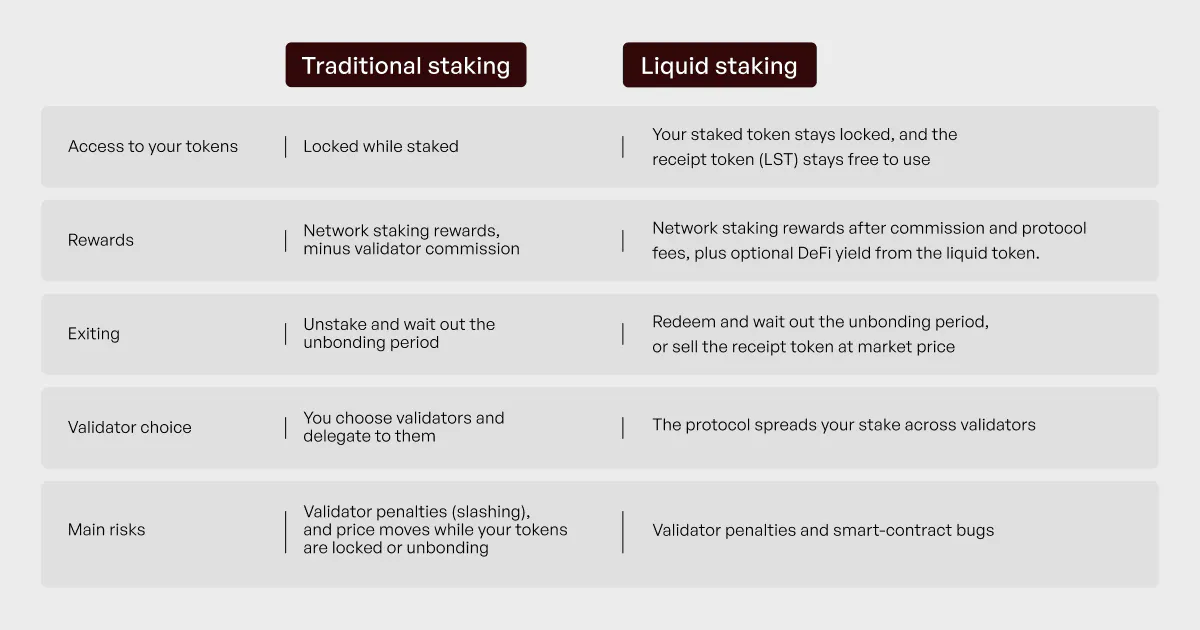
How Is Liquid Staking Different From Traditional Staking?
Traditional staking locks your tokens until the unbonding period ends, while liquid staking gives you a token you can keep using.
Both earn staking rewards, but liquid staking adds flexibility along with a few extra risks.
What Are the Benefits of Liquid Staking
Liquid staking keeps your capital working in more than one place at once. The main benefits are below.
- Your staked position stays liquid, so you can move or trade the token when you need to.
- You keep earning staking rewards while the token sits in your wallet.
- The token can be used in DeFi apps, which opens up a second layer of yield.
- The protocol handles validator work, so you do not need to run or monitor any infrastructure.
How Does Liquid Staking Work on Valdora?
Valdora’s liquid staking protocol runs on ZIG Chain and turns staked ZIG into stZIG. The sections below walk through staking and rewards, then the optional second layer.
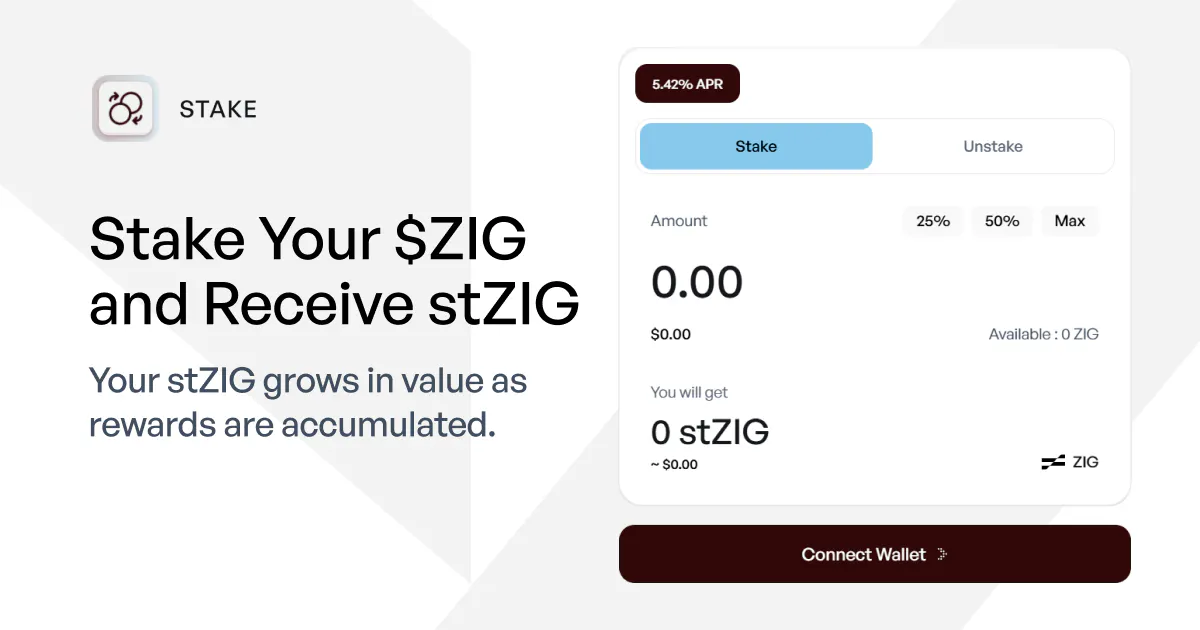
Stake ZIG and Receive stZIG
When you stake ZIG on Valdora, your tokens go to the protocol’s Staker contract. The contract mints stZIG to your wallet and delegates the pooled ZIG to validators on ZIG Chain.
How much stZIG you receive depends on the exchange rate at the moment you stake. The rate started at 1 stZIG for 1 ZIG, but it does not stay there. Rewards are added to the pool instead of being sent to your wallet, so your stZIG balance holds steady while each stZIG becomes redeemable for more ZIG. A later deposit therefore mints slightly less stZIG per ZIG than an earlier one. Because the rate follows the pool, a validator penalty can also pull it down.
How Does stZIG Earn Rewards?
You never claim rewards by hand. They are auto-compounded into the stZIG-to-ZIG rate described above. As a simple illustration with round numbers, if the rate reaches 1.05, 1,000 stZIG would redeem for 1,050 ZIG. This is only an example and does not reflect a live rate.
Can You Earn Additional Yield With stZIG?
Yes. stZIG keeps earning staking rewards while you hold it, and it can also be put to work in supported DeFi apps where it is accepted.
A straightforward example would be a lending market on ZIG Chain that lists stZIG. If you deposited your stZIG there, you could earn the interest borrowers pay, and the stZIG you deposited would continue to reflect staking rewards while it sits in the market. That interest is the second layer, and it comes on top of the first.
This second layer is never guaranteed. The rate depends on how much borrowing demand the market sees, and lending carries its own smart-contract and market risks. Check that a market accepts stZIG before you move any funds.
How to Stake and Unstake ZIG on Valdora
Here is how staking and unstaking with Valdora work.
How to Stake ZIG
- Get ZIG on the ZIG Chain network, and set up a supported wallet.
- Connect your wallet on the Valdora staking page.
- Enter the amount of ZIG you want to stake, keeping in mind the minimum is 50 ZIG.
- Click Stake and approve the transaction in your wallet.
- Check your wallet for the stZIG you receive, which grows in value as rewards accumulate.
How to Unstake stZIG
You can unstake ZIG on Valdora in two ways, and the right one depends on how soon you need your funds.
- Redeeming through Valdora burns your stZIG and places the matching ZIG in a withdrawal queue. After the 21-day unbonding period plus 2 days for Valdora's distribution, you claim your ZIG in the app. A submitted request cannot be cancelled, the minimum is 50 stZIG.
- Selling stZIG on a supported DEX can get you out right away (depending on market conditions), but you receive the market price, which can include a discount or slippage.
What Are the Risks of Liquid Staking?
Liquid staking adds convenience, and it also adds risks worth understanding before you stake.
- If a validator misbehaves or goes offline, part of the stake can be slashed, which lowers what your token is worth.
- A bug or exploit in the protocol's smart contracts could put deposited funds at risk.
- Staking rewards vary with network conditions and fees, so the rate can rise or fall and is never fixed. Valdora also charges a 10% performance fee on staking rewards, which affects the final rewards users receive.
- Using stZIG in other apps adds that app's own smart-contract and market risks, and any extra yield is never guaranteed.
- Redeeming through Valdora takes 21 days plus 2 for distribution and cannot be cancelled once submitted, so it is a poor route when you need cash quickly.
- stZIG can be sold on a DEX, but a thin market can push the stZIG price below the value of the ZIG behind it.
Before you stake, read the unbonding terms in the app.
Staking and the Wider Valdora Ecosystem
Staking is one of the ways to take part in Valdora Points, the program that tracks activity across the platform on a public leaderboard. Staked ZIG counts toward your score, as do positions in Valdora’s USDC vaults, and pairing the two lifts the rate your points build at. The Valdora Points guide walks through how points are earned.
Conclusion
For a ZIG holder, the appeal of Valdora is how much a single decision can open up. One stake gives you a position that keeps growing in value and a place on the Points leaderboard. It also leaves you free to add a vault whenever you are ready, so you can build at your own pace.
Before you begin, read the unbonding terms in the app so the 21 days plus 2 for distribution come as no surprise. Then stake ZIG on Valdora and start your first position today.
Frequently Asked Questions
Is liquid staking safe?
Liquid staking carries real risk. Smart-contract bugs and validator penalties can cost you, and the token price can drift below the value of the ZIG behind it.
What is stZIG?
stZIG is Valdora's liquid staking token for staked ZIG. It reflects your staked position and the rewards that have built up over time.
What is the minimum amount to stake ZIG on Valdora?
The minimum stake on Valdora is 50 ZIG.
How long does it take to unstake ZIG on Valdora?
The standard redeem flow follows the 21-day unbonding period, plus 2 days for Valdora's distribution. If you need your funds sooner, you can sell stZIG on a supported DEX at the market price.
Do I need to claim stZIG rewards manually?
No. Rewards show up in the value of stZIG relative to ZIG, so the amount of ZIG you can redeem for each stZIG rises over time.
Can I use stZIG in Valdora's USDC vaults?
No. Valdora's vaults take USDC deposits, and stZIG is used through staking and supported DeFi apps instead.